
Ontario Public Records Landscape
Ontario agency records do not sit in one database. The City of Ontario is the proper custodian for its own council, permit, code, business-license, and police material. San Bernardino County offices hold recorded instruments, assessor files, local vital certificates, jail data, and voter files. The Superior Court controls judicial case records under court access rules, while California agencies keep statewide vital, business, license, prison, and registry data.
| Ontario Record | Keeper | Online Access | Copy or Use Rule |
|---|---|---|---|
| Deeds, liens, maps, FBNs | San Bernardino County ARC | Public Access System, grantor/grantee index from 1958 | Index is free; images require a copy request or office visit |
| Property and parcel roll | ARC Assessor and County GIS | Assessor Parcel Access, roll files, map viewer | Free access, with protected names or addresses suppressed |
| Court and probate cases | San Bernardino Superior Court | Court Access Portal | Some party searches require login; only lawful remote documents appear |
| Birth, death, marriage | County ARC or DPH; CDPH statewide | No live public certificate database | Authorized and informational copy rules apply |
| City permits and reports | Ontario city departments | Permit portal or published city material | Counter, phone, or CPRA request fills portal gaps |
| Voter registration | County ROV and California SOS | Self-lookup or restricted file request | Not open public data; approved-use rules apply |
| Business and license files | County Clerk, California SOS, DCA | FBN, bizfile, UCC, and license searches | Free searches; copies and county services may have fees |
| Custody and offender data | Sheriff, CDCR, California DOJ | JIMS, CDCR locator, Megan's Law | Only legally disclosable information is shown |
Open access does not mean every detail is visible. Sealed and juvenile cases, adoption files, confidential marriages, protected addresses, some law-enforcement records, and restricted voter data fall outside an ordinary name search. The record's custodian decides what can be released and what must be redacted.
Ontario Recorder Records Access
The Recorder-Clerk Public Access System is the main index for deeds, liens, releases, maps, and other recorded instruments tied to Ontario. ARC confirms grantor and grantee research from 1958 to the present both online and at the Recorder-Clerk office. A grantor transfers an interest; a grantee receives it. Search name variants, since the county warns that its index works like a card catalog and is not the document itself.
| Recorder Field | Entry Type | Required | Use |
|---|---|---|---|
| Disclaimer acceptance | Button | Yes | Opens the search functions |
| Grantor/Grantee | Name | Optional by search | Find parties from 1958 forward; try spelling variants |
| Document number | Number | Optional | Targets one recorded instrument |
| Book/Page | Number pair | Optional | Locates older indexed references |
| Document title | Type | Optional | Narrows deeds, liens, releases, maps, and other titles |
| Date | Date range | Optional | Limits the indexed period |
Results can supply the document number, date, title, parties, and book/page reference. They do not display the actual image on the public web index. Note those identifiers, then order a copy or inspect the office process. ARC lists copy charges effective July 1, 2026 as $4 for the first page, $1.50 for each later page, and $1.50 for a certificate under seal.
The ARC Official Records page shows the county's index, copy, subscription, FBN, and appointment paths.
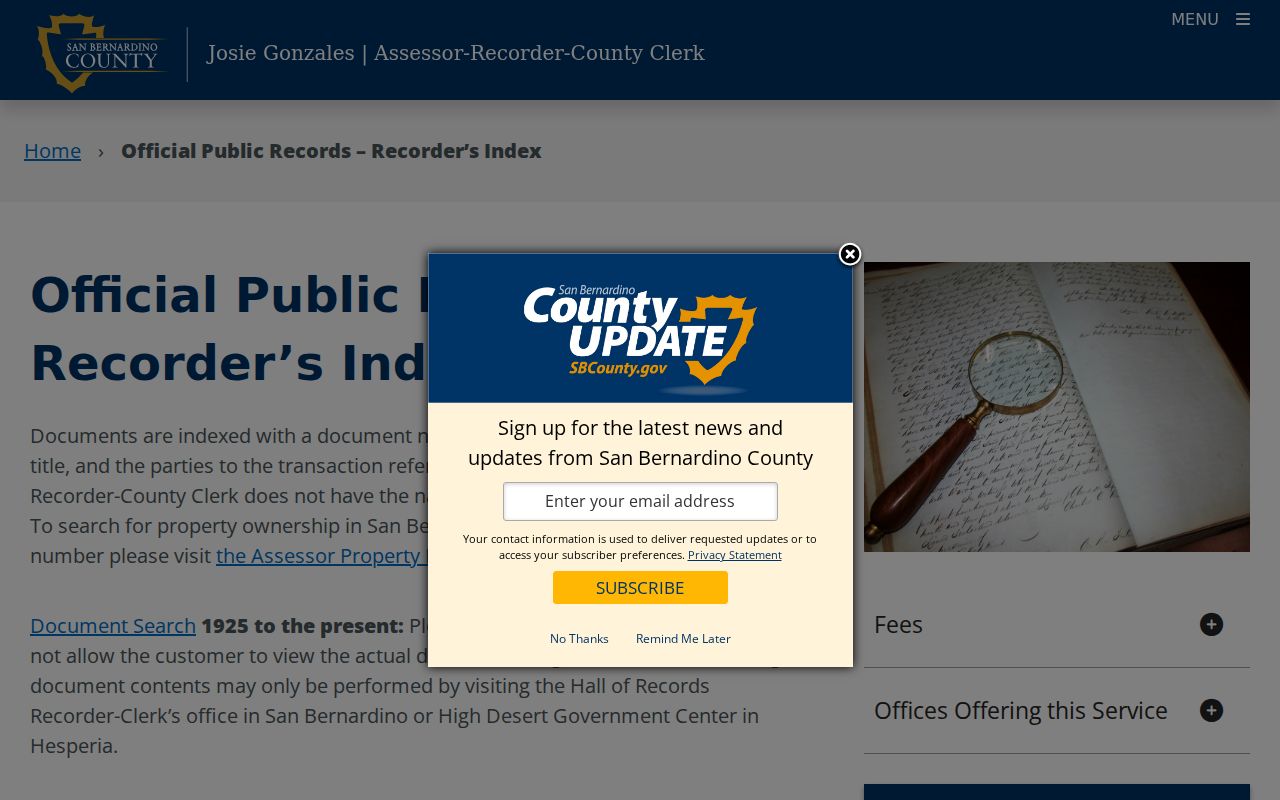
The screen is a useful starting hub, but the index entry still must be matched to a copy when the document's full terms matter.
Note: The recorder does not search property ownership by street address; ARC directs address searches to assessor property information.
Ontario Property Roll Records
Property access uses a different branch of ARC. The Assessor Property Information page connects to Assessor Parcel Access, public roll files, and historical valuation data from 1978 forward. The county map viewer can locate a parcel by Assessor Parcel Number, called an APN, or by address. A situs address is the parcel's physical location; the mailing address is where tax notices go. Those addresses may differ.
The roll can identify an owner and mailing address when the entry is not protected, along with assessed value, parcel data, and exemption information. Government Code section 7928.205 allows protection of certain names and addresses. GIS boundaries and assessor data are useful reference tools, but neither proves current legal title. A recorded deed is the stronger source for that point.
Ontario's jurisdiction line matters. Use the city permit office for property inside Ontario. A nearby parcel outside city limits may instead belong with a county or neighboring-city department.
Ontario Court Records and Copies
The San Bernardino Superior Court online services page routes Ontario state cases to the Court Access Portal. The portal offers case-number search, while party-name search may require login. Its visible fields include first, middle, and last name, business name, and a choice between a standard name and an alias. Calendar and document-viewer functions are separate.
A docket is the court's event list for a case. Searchable case data can still lead to sealed, confidential, or counter-only documents. The civil division charges $0.50 per page for remote documents that the law permits it to display. For other public material, keep the case number and ask the correct clerk counter about terminal inspection, copies, or certification. Probate files can be especially useful in estate and heir research because petitions, notices, and orders may identify decedents, representatives, and relatives.
The court's case information and document page distinguishes online case data from document access.
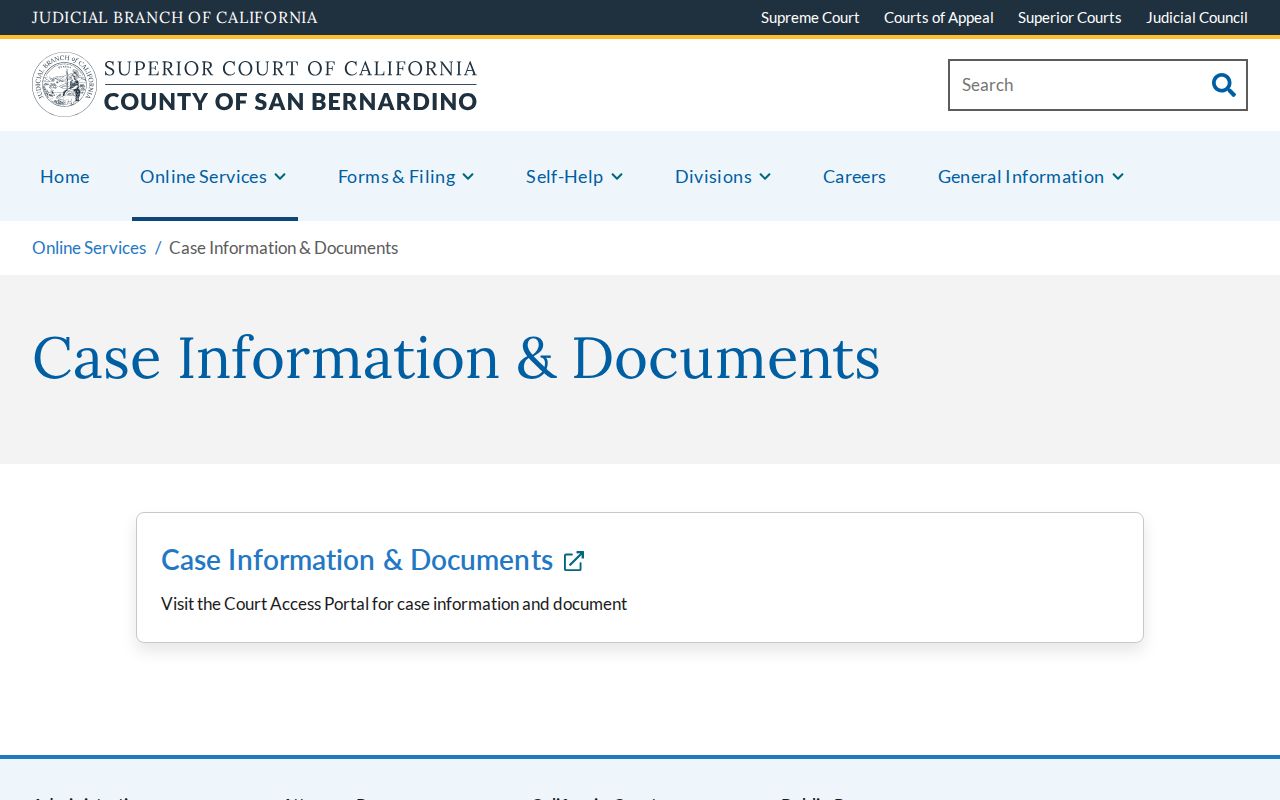
The court page helps users choose the case portal or document service before contacting a clerk about material that is not available remotely.
Ontario Vital Records Rules
For an Ontario event, San Bernardino County ARC supplies certificates for county births and deaths and for marriage licenses purchased in the county. County Public Health also issues county birth and death certificates. CDPH-Vital Records is the statewide fallback. If the event took place or the license was issued elsewhere, use that county or the state office instead.
California Health and Safety Code section 103526 separates authorized certified copies from informational copies. Eligible relatives and other authorized applicants may request an identity-valid copy with a sworn statement. A mailed sworn statement must be notarized. Other requesters can receive a certified informational copy marked as invalid for establishing identity. Confidential marriage certificates go only to the parties or through a court order.
Current county fees are $34 for birth, $26 for death, and $19 for marriage. CDPH lists $29, $24, and $17 for those records, plus $16 for a dissolution certificate. The full divorce case belongs to Superior Court, not CDPH. County applications are available by mail, and local counter rules or the state forms provide the other documented routes.
Note: An archive or genealogy index may identify an event, but only the issuing custodian can provide a certified certificate.
Ontario City Records Channels
The Ontario City Clerk and Records Management Department keeps city proceedings and routes municipal records requests. Published material can include council actions, resolutions, ordinances, boards and commissions, FPPC filings, claims, and city election records. When no specific online form or file appears, the City Clerk counter and phone are the documented fallback.
Address-based city records have their own channels. Building and Planning use Citizen Portal Access for permit status, plan checks, and planning submissions. Code complaints can be made through the city hotline or web form, and Ontario Police Records handles traffic reports and other police record requests subject to privacy and investigation exemptions. City business-license staff provide direct verification because the research did not locate a public searchable local license register.
County permits were not required until about 1936, while some cities began sooner. Ontario permit history should therefore start with city Building or Planning. Neither the county recorder nor the county Historical Archives keeps building permits.
Ontario Records Offices and Portals
Routine copies are usually faster through the office that already has a set process. These three contacts cover much of the Ontario records system. Court locations vary by case type, so the court portal and online services page should identify the proper division before an in-person visit.
ARC Recorder-Clerk
222 W. Hospitality Lane, 1st Floor
San Bernardino, CA 92415
909-387-8306
Superior Court
San Bernardino County divisions
Location depends on case type
Use the court contact directory
ARC's Hall of Records counter is open from 8 a.m. to 5 p.m. The Ontario City Clerk publishes weekday hours that vary on Friday. Confirm current hours and the correct court location before travel, especially when a portal already provides the needed index entry.
Older Ontario Records Split
Modern and historical county files have a clear dividing line. The recorder's online and office grantor-grantee index reaches back to 1958. San Bernardino County Historical Archives focuses on material that predates 1958. The Arrowhead archive portal supports keywords, wildcard truncation with an asterisk, and browsing by collection, creator, or subject.
The archives page lists counter hours but also says the building is currently closed. Email is therefore a required access channel for staff help, not merely an optional convenience. Ontario city proceedings begin after the city's 1891 incorporation, while older land and court trails remain county or state matters. For family history, the California State Archives and local history rooms can supplement the county index with probate, deed, marriage, Great Register, and naturalization material.
- Index
- A catalog entry that points to a record but is not the full record.
- Image
- A scan or digital view of the underlying document.
- Certified copy
- A copy authenticated by the custodian for official use.
- Custodian
- The government office responsible for keeping and releasing the file.
- Exemption
- A law that permits or requires an office to withhold all or part of a record.
Ontario Custody and Police Records
The San Bernardino County Sheriff operates the JIMS inmate locator for current or recent county custody. Search by a ten-digit booking number, or use last name, first name, date of birth or approximate age, and gender. When age replaces birth date, the search spans two years before and after the entered age. The locator can provide a booking number, custody location, and release or visiting context.
Sheriff reports can be requested through the county portal or a station. Some reports are confidential, and completed crime or accident reports may take about ten business days to become available. Ontario Police has a separate city records counter. CDCR handles state prison custody, while California's Megan's Law website publishes only offender data that state law allows to be disclosed. Each system covers a different population.
Ontario Records Privacy Limits
California's open-records law reaches agency files unless an exemption or another law blocks disclosure. Privacy limits are record specific. Vital certificates have authorized-copy rules. Voter registration is not an open people database. Courts may seal cases or protect juvenile, adoption, mental-health, and family details. DMV personal data is restricted, and assessor rolls may suppress protected names and addresses.
California's Safe at Home program gives qualifying participants a substitute mailing address. A missing or substitute address may reflect a lawful safety measure rather than a portal fault. Redaction can also remove account numbers, Social Security numbers, minors' names, signatures, or protected party data. Ask the custodian to cite the exemption when a request is denied or redacted.
Note: California's voter file has separate approved-use rules; the complete process belongs on the Ontario Voter Records page.
Ontario Records and Lien Scams
Real records can be used to make a false demand look official. In April 2025, county officials warned that misleading lien-payment letters cited legitimate filings and pressed recipients to pay third parties. A September warning also told property owners to use official tax-payment channels. The record reference may be genuine even when the requested payment is not.
Compare any demand with the ARC forms and fee schedule. Call ARC, the tax collector, or the District Attorney through an official government page instead of using a number printed in the letter. The county District Attorney's real-estate fraud unit accepts reports about unauthorized or fraudulent property documents. Keep the letter and envelope if fraud is suspected.
Request Ontario Public Records
The California Public Records Act, Government Code section 7920.000 and following, is the fallback for agency files that are not already online. The Act applies to any person. An agency generally has ten days to determine whether it holds disclosable records and may add fourteen days for unusual circumstances. That deadline is for the determination, not necessarily final production. Direct duplication or statutory copy charges may apply, while electronic copies may sometimes be free.
- Identify the custodian. Send city material to Ontario, county agency material to that county department, and court files to the court clerk.
- Check the routine channel first. An index, counter copy form, certificate application, or court portal may be more direct than a broad CPRA request.
- Describe the record by subject, date range, office, names, case number, APN, or document number. Ask for an electronic copy when that format works.
- Submit through the office's portal, email, mail, phone-assisted process, or counter. Keep a copy and note the date.
- If records are withheld, ask for the exemption citation. Narrow an unclear request or seek agency review before considering court action.
San Bernardino County uses NextRequest for non-routine county agency requests. Routine ARC, court, vital, and voter procedures still belong with their specialist offices.
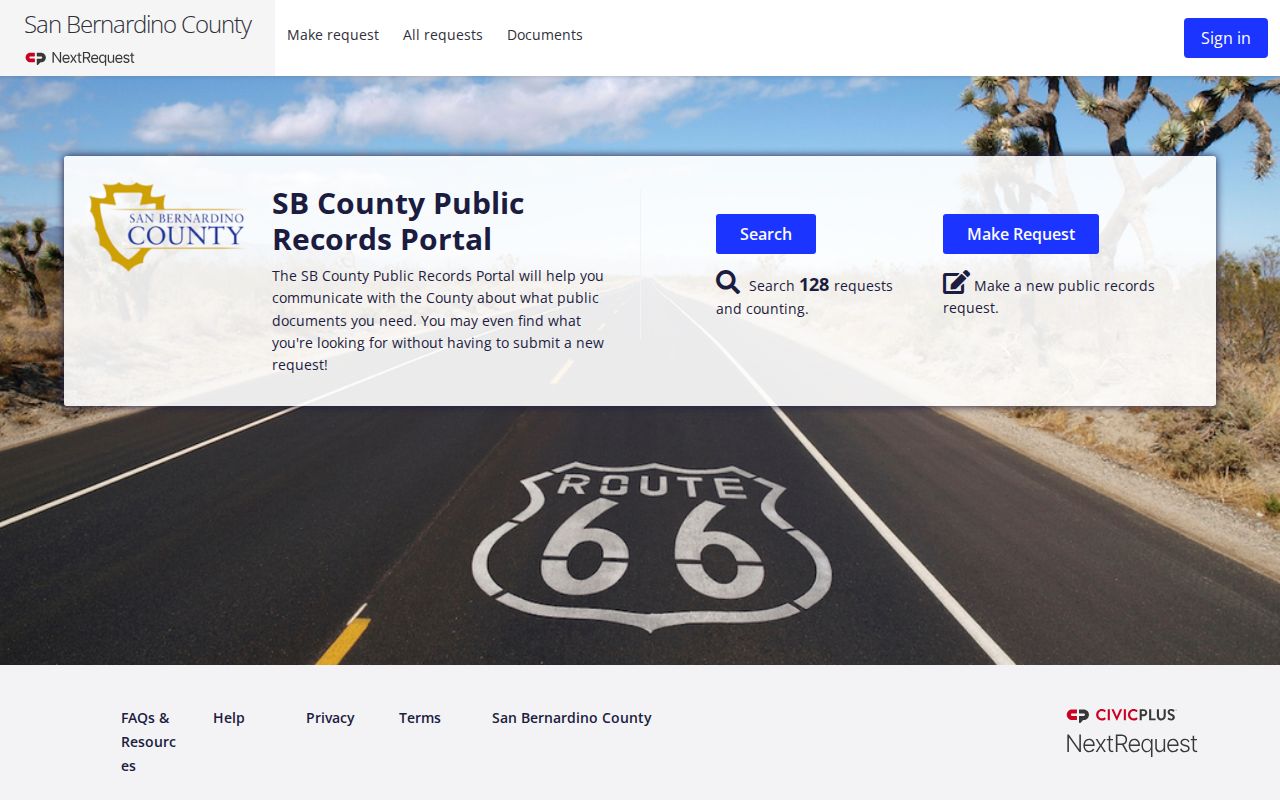
The portal gives county requesters a trackable channel, but it does not replace Ontario City Clerk requests or court access procedures.
Lawful personal use. Use Ontario records for legitimate research and verification. California law prohibits stalking, harassment, intimidation, and misuse of protected personal data.